lutherie.b3rt.dev · Vol. I12 entries · NC High Country · 2026
A B3RT Editorial Ledger · Issue No. 1
Wood, Wire & Watauga.
Source: Pexels · CC Source: Flickr · CC Source: Pexels · CC Source: Pexels · CC
A working record of the people who build stringed instruments in the North Carolina High Country — what they choose to make, what they choose to cut, and why the work outlasts the season.
01
Why build here.
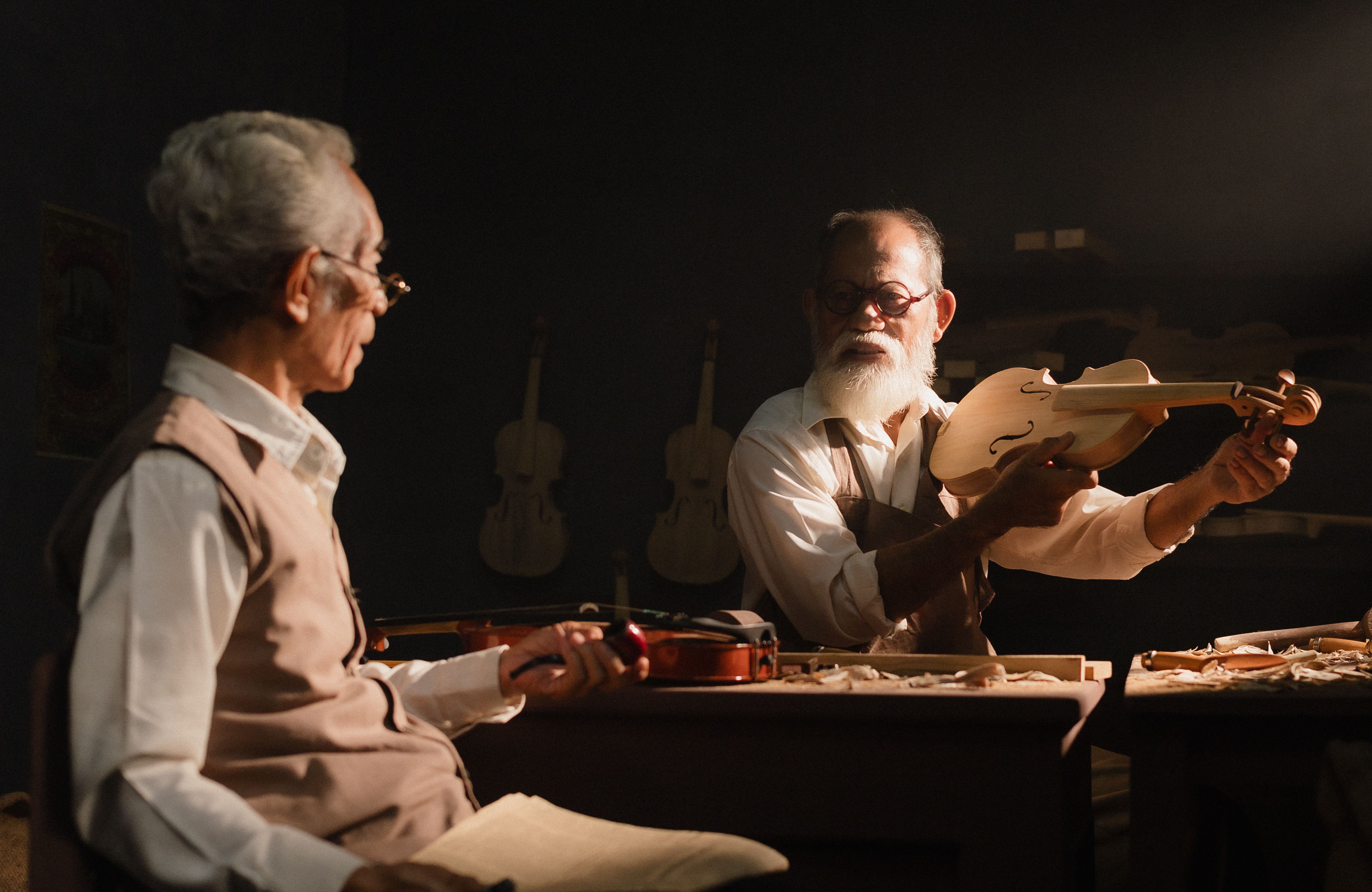
Lutherie is the craft of building and repairing stringed instruments. In the High Country it has become inseparable from the music it was made to serve.
Walk into any hardware store in Newland or Boone and ask for a fret file, a side-bending iron, or a soundhole reamer. Half the time the person behind the counter will know what you mean. The High Country has been building instruments in living memory since the 1880s, when the first J.E. Burnett dulcimers were hammered out of wormwood and poplar in Burnsville, and the tradition never stopped — it slowed, bent, and survived changes in the music. Today the same trade is practiced in one-car garages off Highway 105 and in workshops tucked behind rhododendron in Banner Elk. What follows is a working ledger, not a buyer’s guide: the people, the wood, the finish, and the slow chemistry that turns a board into a sounding object.
On the word itself
Lutherie (from French luth, lute) was originally the building of lute-family instruments: lutes, guitars, and theorbos. American usage has widened the term to include any plucked or bowed fretted instrument — guitar, mandolin, banjo, dulcimer, ukulele. Repair, restoration, and setup are part of the craft, not separate from it.
On the region
The High Country is the highest plateaus east of the Mississippi: a wrinkled escarpment where the Blue Ridge lifts past 5,500 feet and the winters are long enough to slow a glue joint and humid enough to swell a spruce top in July. An instrument built in Boone is already acclimated to Boone. That is why local building matters.
Sources & Further Reading
String instrument https://en.wikipedia.org/wiki/String_instrument In musical instrument classification, string instruments, or chordophones, are musical instruments that produce sound from vibrating strings when a performer strums, plucks, strike...
02
The makers worth knowing.
A roll of working and historical luthiers in the High Country and the wider Southern Appalachians. Historical entries are scanned from public trade journals, regional craft directories, and instrument labels; visit a maker before commissioning based on a name alone.
MakerStephen D. LucasLocationSugar Grove, Watauga Co.SpecialtyAppalachian dulcimerActive1970s – present
The Lucas dulcimer and the Galax teardrop.
Stephen D. Lucas and a handful of Galax, Virginia neighbors in the early 1970s are credited with codifying the hourglass-and-teardrop dulcimer body that has since become the de-facto American standard. Lucas’s contribution was the fret pattern — a six-and-a-half fret diatonic arrangement that simplified the modal tuning schemes of older instruments and made the instrument playable by ear. His shop sat just across the state line, but the timber and the players were always High Country.
Ed Pitt began building dulcimers in Boone in 1976 and never really stopped. The Pitt family workshop remains one of the few High Country shops that still builds entirely by hand — every fret hammered, every scroll cut with a coping saw, every soundhole burned with a homemade brand. Wendy Pitt took over in 2003 and added the chromatic dulcimer — fifteen frets per side, fully equal-tempered. The wait list is two years out.
MakerRobert L. CoxLocationBanner Elk workshopSpecialtyMountain banjo, open-backEra1980s – 2018
Cox banjos and the Avery County tone ring.
Cox built fewer than 200 banjos in his career but trained four apprentices who went on to run their own shops in Asheville and Galax. His contribution was the use of local curly cherry for tone rings — a departure from the brass-and-steel norms of the Northern banjo revival. The Cox banjo is quieter and drier than a Gibson Mastertone, with a more pronounced midrange that sits well under a fiddle without crowding the vocal.
A representative contemporary bench: one- and two-person shops building small runs of dreadnought guitars, weissenborn-style hollow-neck slide guitars, and the occasional Appalachian dulcimer for the festival crowd. Most commission from local hardwood dealers in Spruce Pine and source soundboard spruce from a single West Virginia broker. Lead times are 8–14 months; deposits are non-refundable; resale is informal.
03
Three instruments, three traditions.
The dulcimer, the mountain banjo, and the flat-top guitar. Each carries a different history and a different wood budget.
The Appalachian dulcimer
The mountain dulcimer arrived with the German and Scots-Irish settlers of the late 18th century and evolved in near-isolation until the folk revival of the 1960s. The earliest examples were lengthened violins — three strings, diatonic fret pattern tuned D-A-A. The hourglass body and teardrop are 20th-century refinements; the dulcimer is older than its shape.
A single sitka spruce soundboard, poplar or walnut sides, and a routed ladder brace will produce a playable instrument in 30–40 hours of work. The challenge is the fret spacing: equal temperament on an unfretted diatonic scale is a math problem disguised as a craft problem.
The mountain banjo
The mountain banjo has at least three ancestors: the African gourd banjo carried north in the 18th and 19th centuries, the minstrel-era tambourine-banjo hybrid of 1840–1880, and the modern open-back banjo codified by Philadelphia and Gibson after 1900. A homemade mountain banjo in the older style — a tack-head, a skin head, a three-string neck — is functionally a different instrument, even if the catalogue lookup says “banjo.”
Blocking inside a banjo rim matters more than the rim itself. A properly blocked rim transfers string tension into sound rather than into a parallelogram; a poorly blocked rim will collapse on you inside a year.
The flat-top guitar
The flat-top arrived in Appalachia through mail order in the 1890s and stayed. Local building took off after WWII when returning GIs learned lutherie on the GI Bill — at the Gibson and Martin apprenticeships, but also in the smaller shops that dotted the eastern Blue Ridge from the 1950s onward. The High Country produces a small but steady stream of dreadnoughts, OM, and parlor guitars for the regional bluegrass and Americana scene.
Woodworking schools
Two lutherie programs within driving distance of Boone/Watauga: the Appalachian School of Luthiery (Mars Hill) and the American Lutherie Academy (Asheville). Short workshops run periodically at the John C. Campbell Folk School in Brasstown. Each runs weekend dulcimer builds through multi-year guitar residencies. Mars Hill in particular has produced a disproportionate share of working North Carolina luthiers since 1998.
04
Craft: wood, finish, and tools.
The boring decisions are the most important ones. What wood, what glue, what finish, and what is on the bench.
Wood selection, by use
Wood
Typical use
Tone
Notes
Sitka spruce
Guitar soundboard
Strong fundamental, headroom
Workhorse. Most factory dreadnoughts. Ages gracefully.
Adirondack spruce
Guitar soundboard
Loud, complex overtones
Rarer, stiffer. Excellent for heavy-attack bluegrass flatpicking.
Engelmann spruce
OM, parlor
Warmer, fundamental-rich
Less headroom than Sitka; rewards a lighter touch.
Honduran mahogany
Back & sides, neck
Dry, woody, focused
Martin 15-series wood. Blues and recording-guitar tone.
African mahogany
Back & sides, neck
Slightly brighter
CITES-sustainable alternative to Honduran; near-identical working.
Indian rosewood
Back & sides, fretboards
Deep, bell-like
Pre-2017 default. Verify CITES documentation before purchase.
Madagascar rosewood
Premium instruments
Tight, focused, refined
CITES II listed; export permits required.
Claro walnut
Back & sides alt
Mid-forward, dry
Domestic (CA-grown). Attractive figuring; slightly softer than rosewood.
Myrtle
Back & sides alt
Bright, ringing
Pacific Northwest standby. Excellent figuration in the right board.
Cherry
Banjo rims, dulcimer
Bright, warms with age
Mountain-banjo tradition. Darkens to amber in 5 years.
Red spruce
Dulcimer soundboards
Loud, articulate
Pre-war Martin wood. Spruce Pine, NC is a US distribution point.
Poplar
Dulcimer sides
Neutral
Cheap, stable, paints well. The default student wood.
Rosewood alternatives — the honest list
Indian rosewood was the guitar industry’s default back-and-sides wood for 80 years. CITES II listing in 2017 changed the math. The credible 2026 alternatives in order of adoption: Claro walnut (visually striking, softer), pau ferro (closest tonal match, dense), ovangkol (figured, brown), ziricote (dramatic spider-webbing, brittle), and myrtle (PNW standby). None are “the new rosewood”; they are different woods. Build for the tone you want, not the wood you remember.
Finish chemistry, briefly
Most modern luthier finishes are solvent-borne lacquers or catalyzed varnishes. The two families you will actually use:
Nitrocellulose lacquer. Solvent-borne, evaporative cure, repairable. The Gibson & Martin standard until 2010. Pros: repairs invisibly, ages well, lets the wood resonate more freely than any film finish. Cons: 8–12 coats over 4–6 weeks, regulated solvents. Water-borne nitro is a credible modern alternative.
Conversion & catalyzed varnish. Two-part chemistry that cross-links rather than evaporating. Hard, durable, but largely irreparable — a refinish is sanding to bare wood. Used by Taylor since 2005 and increasingly by independent builders who want a factory-grade finish.
Hand-rubbed oil & wax. Boiled linseed oil (with metallic driers), tung oil, or Tru-Oil, topped with paste wax. The oldest finish, the thinnest finish, the most repairable. A rubbed finish lets the wood breathe; many dulcimer builders use it for that reason.
Fret press or deadblow + caulCaul is cheaper and gives more control for partial refrets.
06
Inlaying chisels (Lawrence)Four sizes. Pearl, abalone, and MOP inlay work.
07
Hide glue pot & brushHot hide glue is still the luthier’s standard for joints that must come apart.
08
Shooting board with planeJointing sides, neck angles, end blocks. The most underrated bench accessory.
09
Calipers & a steel ruler12" rule, 6" digital caliper, machinist square. Measure twice.
10
Side-bending iron (or hot pipe)For guitar and dulcimer sides. Electric blanket pipes are cheaper; irons faster.
11
Soundhole reamerOne tool for one job. Sharpen, do not replace.
12
Notched straightedge & lightFor reading a guitar top under tension. Sight down the neck with a raked light.
05
Repair, mistakes, and how a vintage survives.
Eight mistakes the bench has seen a hundred times, a working rule on repair vs build, and a vintage-care checklist.
Rush the glue-up.
Hide glue gels in 30 seconds at workshop temperature. Plan every clamp, dry-fit the box three times, have your cauls pre-cut. A guitar joint that looks perfect on a Monday will telegraph every clamp skip by Friday.
Use Titebond on a joint you may need to open.
Hide glue for everything structural on a guitar. Titebond is fine for a bench jig; it is a one-way ticket for a neck joint.
Skip a soundboard tap-test.
Knock on the dry-braced top before closing the box. The dead note and the live note should sit one step apart on a dreadnought; an octave apart on an OM. If it sounds like a snare drum, remove a brace.
Over-sand the binding.
Bindings hide a joint that does not have to be perfect; the wood inside the binding does. Stop sanding at the edge.
File the nut before leveling the frets.
If the open strings buzz but the 12th fret doesn’t, the problem is almost never the nut. Level, crown, and polish first.
Trust the factory setup.
Even a Martin or a Taylor benefits from a $200 professional setup on arrival: fret level, nut filing, saddle compensation, action drop. Factory setup is shipping-shipped, not playing-tuned.
Build in an unconditioned shop.
Wood moves with humidity. A guitar built in July at 70% RH will crack in January at 25%. Aim for 40–50% RH year-round.
Refinish a vintage.
The most common mistake in the trade. A 1950s Gibson or Martin loses 60–80% of its market value the moment the original finish comes off. Clean, level, and polish what is there.
Repair vs. build — when to do which.
A working rule: if the instrument is worth more than a deposit on a new build of equivalent quality, repair it. A good repair preserves wood, tone, and break-in, and costs a third of a build for a tenth of the lead time. Reserve new builds for instruments that no longer suit the player — wrong scale length, neck profile, aesthetic — not for instruments with a failed joint. A reset neck is routine on a Martin pre-1990; a lifted top from a closed pore is a repair; a sunken soundboard is a repair up to a point. A broken headstock on a vintage acoustic is a repair if the original piece can be rejoined; a collapse across the grain is usually retirement.
Vintage instrument care — a working checklist
Interval
Action
Why
Daily
Wipe down after playing
Sweat acids attack the lacquer; accumulated rots the strings
Weekly
Check the case humidifier (40–50% RH target)
The case is the instrument’s actual environment, not the room
Monthly
Inspect the neck relief with a straightedge
Wood moves seasonally; a winter adjustment saves a spring crack
Yearly
Pro setup: fret polish, nut lube, action check
A $100 annual service catches 90% of warranty issues
5 years
Full inspection: braces, bridge plate, neck joint
The point at which loose braces announce themselves
Never
Do not refinish a vintage
You cannot restore the patina you removed
06
An afterword on tradition.
Regional music and luthie are not the same thing; they are two halves of the same craft.
It is fashionable to say the dulcimer is dying or the mountain banjo is a museum piece. The benches around here disagree. The dulcimer is being built in numbers it has not seen since the Bicentennial; the open-back banjo is in a quieter revival than the Gibson-style bluegrass banjo, but it is real; the High Country produces a steady stream of dreadnoughts, OMs, and parlor guitars commissioned by players who can drive to the shop and pick up their instrument in person.
What makes the regional tradition durable is that music and luthiery feed each other. Galax sessions still need dulcimers; the Union Grove Fiddler’s Convention still needs banjos; the Methodist churches on the Yonahlossee Road still need guitars tuned down to Eb and played with a heavy thumb. The High Country has always built what it plays, and what it plays is the music the instruments were built to serve.
Sources & Further Reading
A luthier is a craftsperson who builds or repairs stringed instruments, especially lutes and violins.en.wikipedia.org